Overview
After presenting the main points on the homepage, I outline the line of reasoning that the site seeks to develop through the diagram below. In it, the yellow cells represent fundamental questions that the site aims to answer and defend honestly. The ultimate goal is to demonstrate that, by coherently answering these questions, one can sincerely affirm that the Catholic faith is the truth.
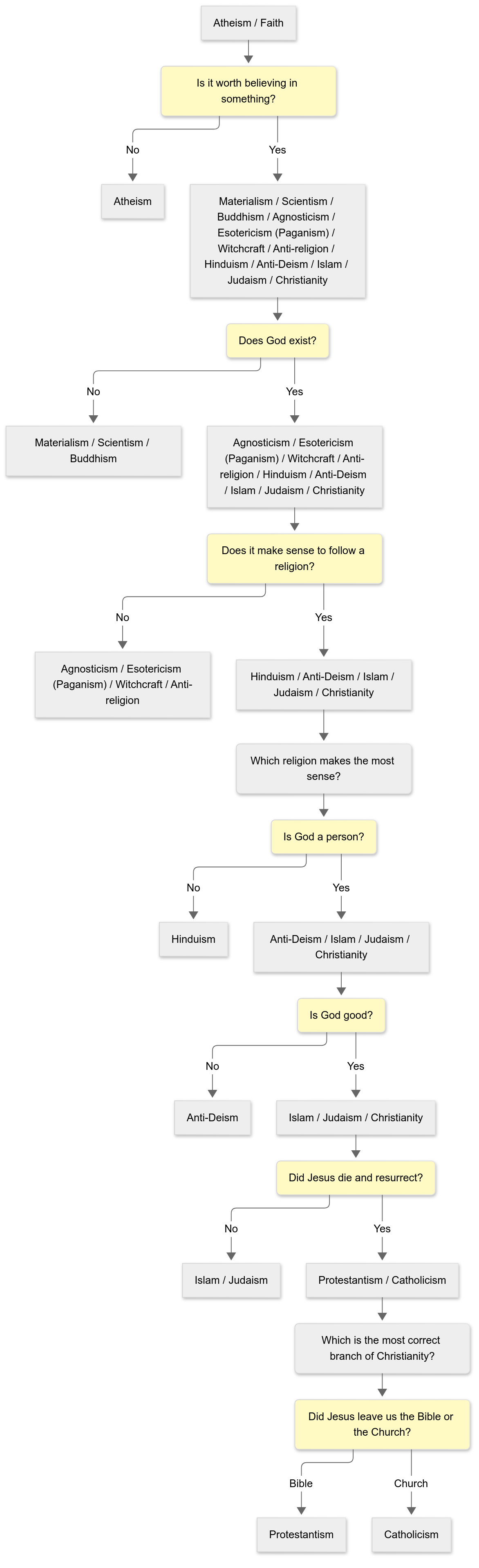
The different types of worldviews and belief systems mentioned in the diagram are defined as follows:
- Atheism: denies the existence of God and, consequently, rejects any form of faith.
- Materialism: believes that only the physical world exists and that only it can be explained.
- Scientism: claims that everything can be understood exclusively through science.
- Buddhism: more a philosophy than a religion; it does not believe in a creator god but in philosophical and spiritual principles.
- Agnosticism: admits the possibility that God exists but claims that nothing can be known about Him; it may also hold that all religions are equal or complementary, without recognizing a single truth.
- Esotericism (Paganism): believes in supernatural forces, spirits, reincarnation, or natural energies, but not in a creator God; includes beliefs such as candomblé, umbanda, ásatrú, or Hellenism.
- Witchcraft: similar to esotericism but focused on manipulating supernatural forces for material gain.
- Anti-religion: considers all religions false and faith as something negative, actively seeking to deconstruct it.
- Hinduism: a religion that admits various deities but, in essence, does not recognize a personal God, only an impersonal creative force.
- Anti-deism: encompasses beliefs that acknowledge the existence of God but rebel against Him, such as Satanism and its branches.
- Islam: follows the teachings of Muhammad and professes faith in a creator, sovereign, and good God but denies the divinity of Jesus Christ.
- Judaism: based on the teachings of Moses and the prophets, acknowledging a creator God but rejecting the divinity of Christ.
- Christianity: founded on the teachings of Jesus Christ, believing in a creator, sovereign, and good God, and affirming the divinity of Jesus.
- Protestantism: rooted in Martin Luther’s principle of Sola Scriptura, which holds that the Bible is the only source of authority for faith and practice, rejecting the authority of the Catholic Church.
- Catholicism: professes faith in the Catholic Church founded by Jesus Christ, recognizing it as the one true Church and the guardian of the fullness of the means of salvation.
Now you can check the main questions or additional thoughts to read in the navigation menu.
Or click here to go to the first question