
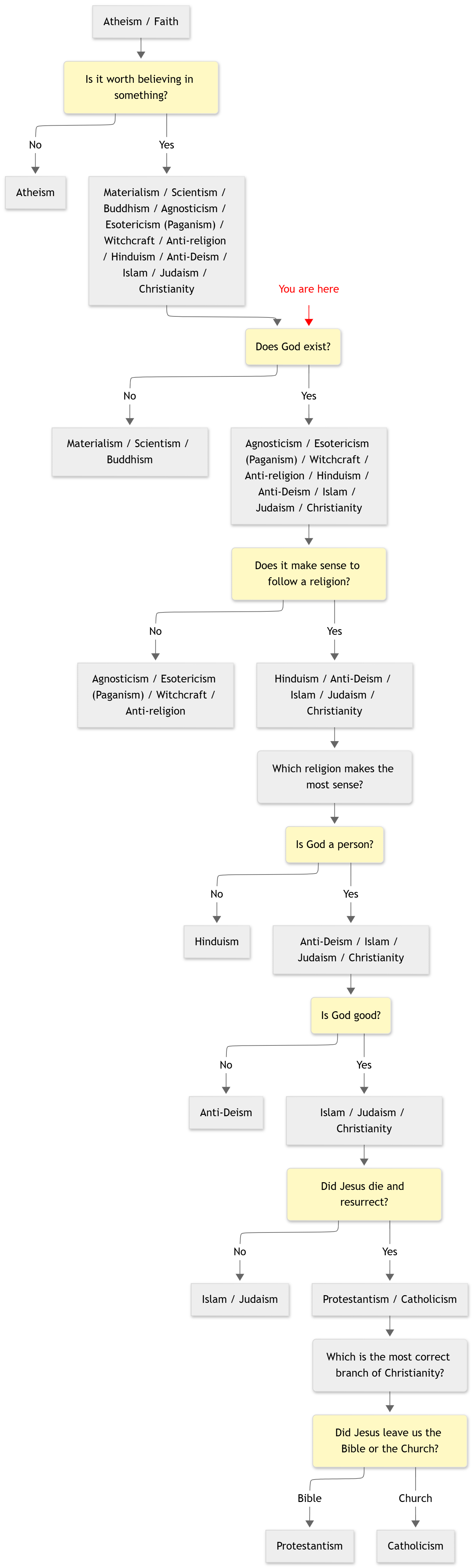
God exists
When demonstrating that God exists, it becomes necessary to discard three alternative belief systems that become incompatible with this conclusion. They are:
1. Materialism
Materialism claims that only matter exists.
However, if God exists as the cause beyond the universe, then reality is not reduced to the material.
Believing only in matter would ignore that the origin of matter itself points beyond matter. Trying to explain everything solely through material causes fails when matter and the cosmos began.
2. Scientism
Scientism is the belief that only science can produce valid knowledge.
However:
- Science studies nature, while God, as the Creator of nature, is beyond the limits of natural laws.
- Science cannot directly study what lies outside the system it investigates.
- Even so, science itself offers abundant indications of a Creator, such as the origin of the universe, the order of natural laws, and fine-tuning.
This does not mean rejecting science. It remains essential for human progress. The mistake lies in using science as the exclusive criterion for metaphysical decisions.
3. Buddhism
Buddhism, in its classical form, is a non-theistic tradition. It does not recognize a creator God.
- Buddha is not considered a creator deity, but an enlightened teacher.
- Even when it acknowledges divine beings (devas), Buddhism affirms that none of them is a creator.
- The Buddhist path focuses on inner enlightenment, not on a relationship with a supreme Creator who grounds existence.
Thus, if God exists as Creator and ultimate foundation of being, the traditional Buddhist worldview cannot be adopted as the final explanation of reality.
The universe had a beginning. From nothing, nothing comes, so the universe needs a cause beyond itself. A physical description of the beginning — Big Bang, multiverse, and the like — still needs a cause. The universe’s constants are finely tuned for life. Evolution describes variation; it does not close the question of God. Everything that exists has a reason beyond itself. Taken together, these reasons point to God as the cause and ground of the universe — without yet settling whether that cause is personal.
The argument
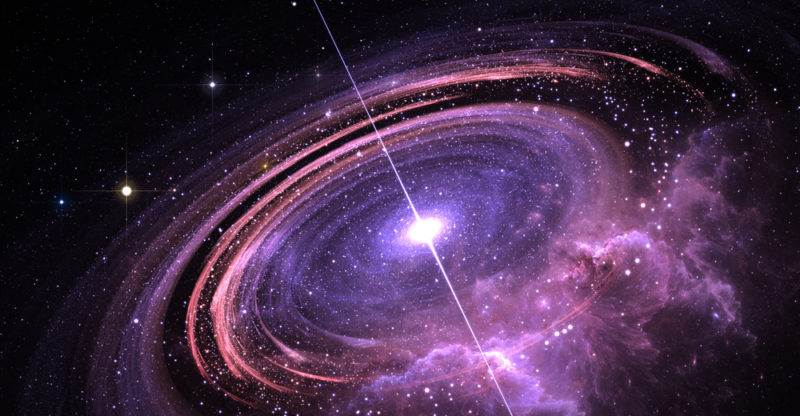
Cosmological observations (cosmic microwave background, expansion of space, abundance of light elements) point to a beginning of the universe. Like rewinding a videotape, going back in time we find density and temperature rising to a finite initial state. The Borde–Guth–Vilenkin theorem shows that expanding universes, even with quantum fluctuations, cannot be past-eternal. If something began, it is not self-explanatory. Just as a campfire does not light itself, the cosmos requires a cause for its existence, distinct from it and prior to all physical processes.
- Stephen Hawking - A Brief History of Time
- Alexander Vilenkin - Many Worlds in One
- Alan H. Guth - The Inflationary Universe
- Genesis 1:1 - In the beginning, God created the heavens and the earth.
- Hebrews 11:3 - By faith we understand that the universe was formed by the word of God.
- John 1:3 - All things came to be through him, and without him nothing came to be.
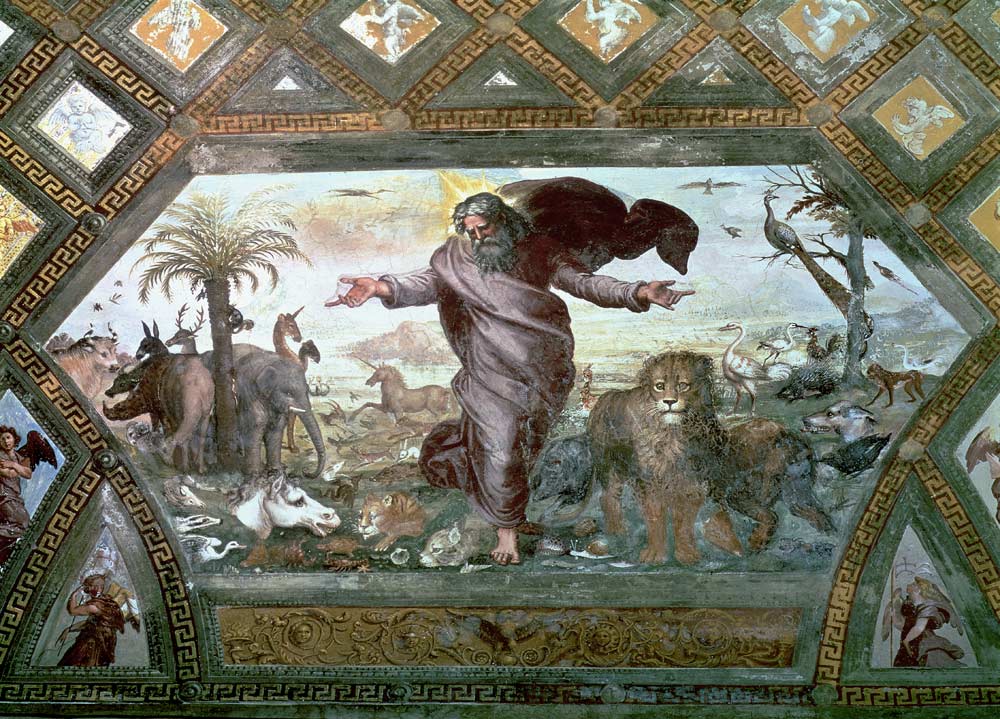
Nothing is not a kind of “something” that is empty; it is total absence of being. If at any moment there had been only nothing, nothing could arise. Since there is something, and since the universe began, the ultimate explanation cannot be nothing. The universe cannot be its own reason for existing. Just as a house does not build itself, the cosmos requires a cause of being beyond itself — a ground that gives existence, not merely rearranges what already exists. Whether that cause is personal is a further question; that there must be such a cause is the point here.
- Robert J. Spitzer - New Proofs for the Existence of God
- William Lane Craig - On Guard
- Thomas Nagel - Mind and Cosmos
- Psalm 19:2 - The heavens declare the glory of God; the firmament proclaims the work of his hands.
- Isaiah 45:18 - He is God who formed the earth ... to be inhabited.
- John 1:3 - All things came to be through him.

Models such as the Big Bang, inflation, and multiverse hypotheses aim to describe the “how” of physical processes, not the ultimate “why.” To say our universe came from another, or from an inflationary field, only pushes the question back: why do those systems exist and obey laws at all? It is like plugging a device into a different power strip: you still need the power plant. Multiplying universes does not yield a reason for being; all require grounding. Useful physical descriptions therefore do not remove the need for a cause beyond the physical story.
- Max Tegmark - Our Mathematical Universe
- George Ellis & Joe Silk - Scientific Method: Defend the Integrity of Physics (Nature, 2014)
- Roger Penrose - Cycles of Time
- Acts 17:24 - The God who made the world and all that is in it, Lord of heaven and earth.
- Romans 1:20 - Ever since the creation of the world, his invisible attributes—eternal power and divinity—have been understood.
- Colossians 1:17 - He is before all things, and in him all things hold together.

Physics has shown that natural phenomena are governed by extremely precise formulas, and any minimal alteration would make life impossible. Key examples include:
- Weak nuclear force: if altered by about 1 part in 10^100, life would be impossible because it would cease to regulate essential nuclear processes within the atom.
- Cosmological constant: if adjusted by only 1 part in 10^120, the universe would either expand too rapidly or collapse, making life impossible.
- Atmospheric oxygen: currently ~21%. If it were 25%, spontaneous fires would occur; if 15%, there would not be enough oxygen to sustain life.
- Earth–Moon distance: if smaller, it would cause climatic and tidal instabilities; if greater, the stability of tides and climate would be compromised, making life unviable.
- Atmospheric CO₂ levels: in excess, it would trigger runaway greenhouse warming; if too low, photosynthesis would fail and life would suffocate.
Beyond these, at least 122 fundamental constants have been identified that must be exactly calibrated. Their number and sensitivity reinforce intentional fine-tuning. The probability of all coinciding by chance is practically zero—about 1 in 10^10^123, according to Oxford mathematician Roger Penrose—strongly pointing to an Architect of the universe.
- Robert Spitzer - New Proofs for the Existence of God
- Contemporary Apologetics: The Truth of the Christian Faith
- William Lane Craig - On Guard
- Roger Penrose - The Road to Reality
- Wisdom 11:20 - You have arranged all things by measure and number and weight.
- Psalm 19:2 - The heavens declare the glory of God; the firmament proclaims the work of his hands.
- Isaiah 45:18 - He is God who formed the earth and made it, who established it, who did not create it a waste, but formed it to be inhabited.

Natural selection explains gradual changes, like an artisan sanding details. However, certain structures seem to require a “complete package” to work. The bacterial flagellum has parts such as rotor, stator, hook, and filament; if one is missing, the motor does not turn. In integrated systems, adding parts piece by piece does not yield clear intermediate function. Think of a car engine: a piston without a spark plug, or without a crankshaft, does not move the vehicle. Thus, evolution can describe micro-variations but does not by itself account for the leap to integrated complexity, nor does it prove that God does not exist. This does not overthrow science; it simply indicates that there is more to life’s origin than mutations and selection.
- Michael Behe - Darwin’s Black Box
- Stephen C. Meyer - Darwin’s Doubt
- William Lane Craig - Reasonable Faith
- Job 38:4 - Where were you when I founded the earth?
- Psalm 139:14 - I praise you, because I am wonderfully made; wonderful are your works!
- Genesis 1:27 - God created man in his image...

Observing reality, we notice that nothing is the cause of itself: a tree depends on a seed, the seed on a prior tree, and both on light, water, and soil. Everything points to a cause outside itself. The chain of dependent beings cannot go on forever without a first reason that is not itself dependent. The human being, as part of creation, does not find within himself the ultimate reason for his existence. This implies that purpose and being are grounded in something absolute — God, the first cause and the ultimate end of all things.
- Aristotle - Metaphysics
- Thomas Aquinas - Summa Theologica
- Robert J. Spitzer - New Proofs for the Existence of God
- Acts 17:28 - In him we live and move and have our being.
- Romans 11:36 - For from him and through him and for him are all things.
- Ecclesiastes 3:11 - He has made everything appropriate to its time, and put the timeless into their hearts.