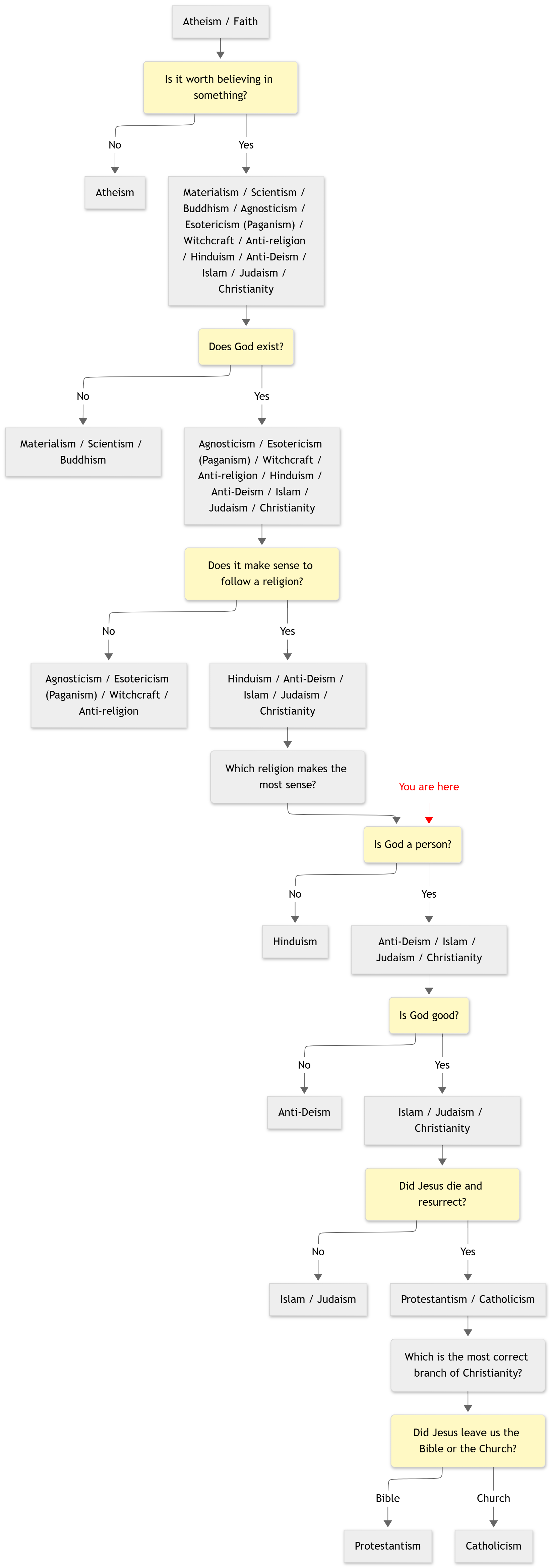
God is a person
When demonstrating that God is a person, it becomes necessary to discard the possibility of belief in classical Hinduism, for its understanding of the divine does not correspond to a personal God in the philosophical and theological sense.
Hinduism and the Impersonality of Brahman
In Hinduism, the ultimate reality is not a personal God, but Brahman, understood as an impersonal cosmic force, infinite and unlimited.
This Supreme Reality is seen as the source of all things, yet it does not possess personality, individual will, or a direct relational capacity with human beings in the way theistic traditions affirm.
The Deities in Hinduism
Although there are various deities worshipped, they are understood as manifestations or aspects of Brahman, not as an absolutely personal God. Among them are:
- Brahma, the Creator
- Vishnu, the Preserver
- Shiva, the Transformer
Most Hindus follow traditions that emphasize one of these deities:
- Vaishnavism (centered on Vishnu)
- Shaivism (centered on Shiva)
- Shaktism (worship of the Supreme Goddess)
In all these traditions, however, such deities are understood as modes of manifestation of the divine, not as the fully personal Ultimate Being.
Conclusion
If God is a person — that is, a supreme Being endowed with will, consciousness, intention, and relational capacity — then the Hindu view, based on the notion of Brahman as an impersonal reality, cannot be accepted as a true explanation of the nature of God.
A universe that began is not the work of impersonal eternal laws; it points to a who, not a what. Big Bang and multiverse stories name a mechanism, not a will that starts existence. Impersonal laws describe regularities; they do not create from nothing. From nothing, nothing comes; giving existence requires intellect and will. Free will is the mark of personhood; the cause of free persons is personal. Therefore God is a person — a first cause with intelligence and will.
The argument
Just as a film starts with its first frame, the universe points to a real beginning. Results concerning singularities and expansion show that space-time, when traced backward, cannot extend infinitely into the past. Eternal impersonal laws do not by themselves explain a beginning: laws describe what already is; they do not decide that something should start. A beginning therefore points beyond a what toward a who — a cause that can originate. It is like a clock striking at 6:00 — the hands explain the time, but not why the clock started running.
- Arvind Borde, Alan H. Guth, Alexander Vilenkin - Inflationary Spacetimes Are Not Past-Complete (2003, Phys. Rev. Lett.)
- Stephen Hawking, George F. R. Ellis - The Large Scale Structure of Space-Time
- Alexander Vilenkin - Many Worlds in One
- Genesis 1:1 - In the beginning God created the heavens and the earth.
- Hebrews 11:3 - By faith we understand that the universe was ordered by the word of God.
- Romans 1:20 - Ever since the creation of the world, his invisible attributes of eternal power and divinity have been understood through what he has made.

Talking about the Big Bang or multiverses is like discussing different engines for a car: no matter the model, all still require a driver and a key. The multiverse merely shifts the question — 'why does this collection of universes exist?' — without explaining why there are laws and conditions that make it possible, or who wills that they hold. Observations and theorems suggest that many eternal inflation scenarios also have a boundary in the past. A mechanism is not a will; naming how the early cosmos behaved does not name a personal agent who starts existence.
- George F. R. Ellis, Joe Silk - Scientific Method: Defend the Integrity of Physics (Nature, 2014)
- Alan H. Guth - Eternal Inflation and Its Implications (2007, J. Phys. A)
- Audrey Mithani, Alexander Vilenkin - Did the Universe Have a Beginning? (2012, arXiv)
- Wisdom 13:5 - Through the greatness and the beauty of creatures, one comes to know by analogy their maker.
- Isaiah 40:26 - Lift up your eyes on high and see: who created these things?
- Acts 17:24 - The God who made the world and all that is in it is Lord of heaven and earth.
Laws are like the rules of a game or a recipe for a cake: they explain how things happen but do not put the dough in the oven or bring ingredients into being. Gravity, particles, and equations do not 'choose' to start existence; they operate only once something already exists. To come from absolute nothingness, a cause capable of acting freely — something personal — is required. Without that, we would have mere empty descriptions, like a musical score without musicians.
- Paul Davies - The Mind of God
- John D. Barrow - The World Within the World
- David Albert - On the Origin of Everything (critique of 'A Universe from Nothing', 2012)
- Psalm 33:9 - For he spoke, and it came to be; he commanded, and it stood firm.
- Jeremiah 10:12 - It is he who made the earth by his power, who established the world by his wisdom.
- Hebrews 3:4 - Every house is built by someone, but the builder of all things is God.
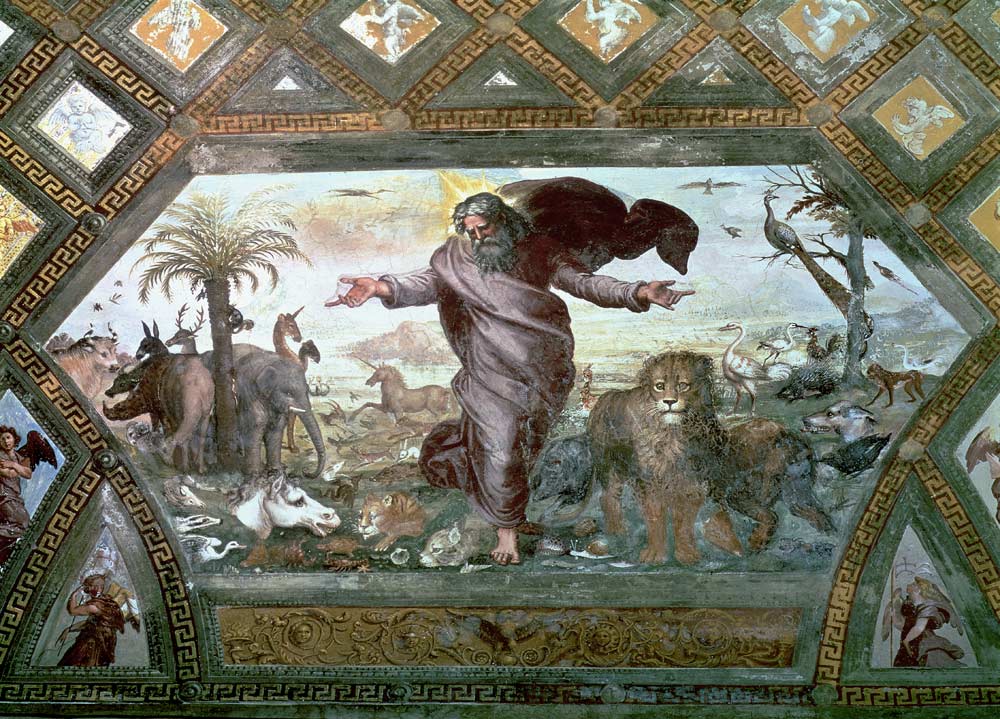
In everyday life, nothing appears without reason: a letter does not exist without an author, a house does not rise without a builder. If the universe began, the ultimate explanation must have the power to give existence itself, not merely rearrange what already exists. Giving existence is an act: it requires intellect to know what is given and will to give it. A personal first cause, with intelligence and will, explains why there is something rather than nothing and why the laws are intelligible. This cause is not 'one more thing' in the universe but the foundation of all reality.
- Robert J. Spitzer - New Proofs for the Existence of God
- William Lane Craig, James D. Sinclair - The Kalam Cosmological Argument (Blackwell Companion to Natural Theology)
- Richard Swinburne - The Existence of God
- John 1:3 - All things came to be through him, and without him nothing came to be.
- Revelation 4:11 - Worthy are you, Lord, for you created all things; because of your will they came to be and were created.
- Genesis 1:1 - In the beginning God created the heavens and the earth.

To create something new requires free will. The decision to bring the universe into existence shows that the cause possesses intellect, will, and freedom — characteristics proper to a person. We ourselves are free persons; an effect cannot outstrip its cause in kind. Therefore the cause of free persons cannot be less than personal. God is not a blind force but a personal being who knows and wills.
- Reasonable Faith – William Lane Craig, 2008
- Exodus 3:14 - 'I am who am.'
- John 17:3 - 'Now this is eternal life, that they should know you, the only true God, and the one whom you sent, Jesus Christ.'