
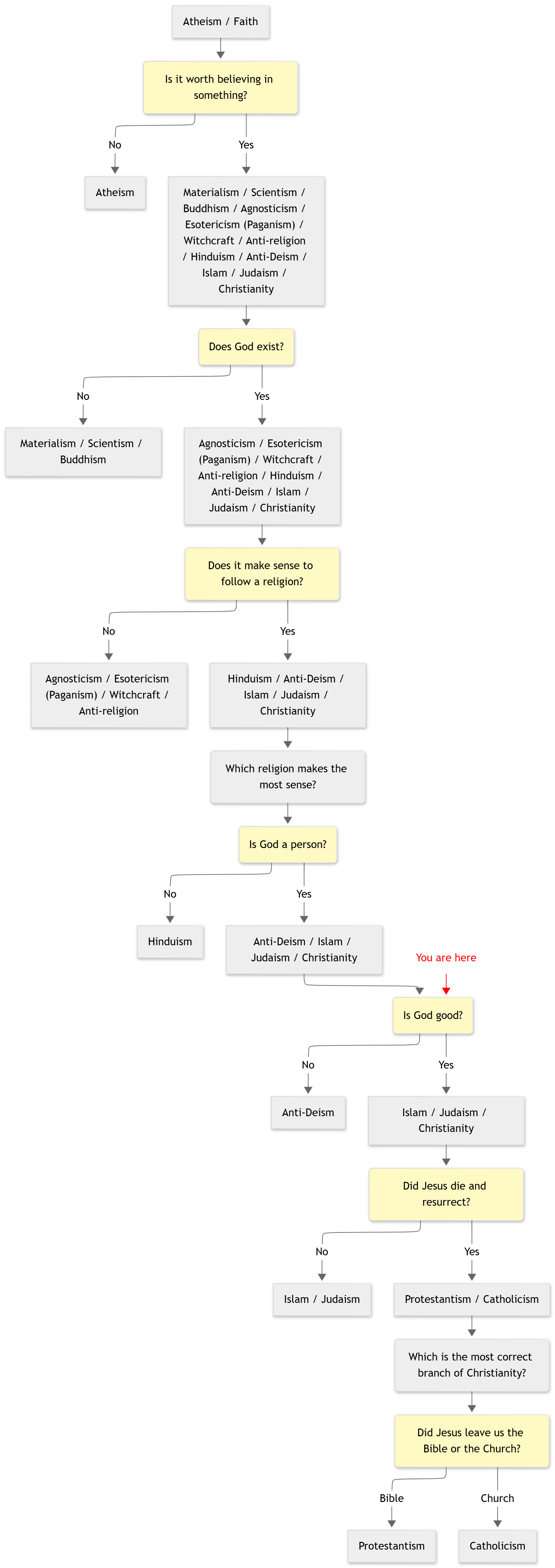
God is good
If God is good, then anti-deism — active opposition against God — is incoherent.
Anti-deism presupposes “fighting against God.” That stance does not hold if God is:
- The supreme Being and creator of all things, infinitely superior to any creature.
- The source of goodness, who desires what is good for people and understands them perfectly.
- The One who created each human being with a purpose and knows their structure and needs intimately.
Opposition to such a God is irrational for two reasons:
-
Logical impossibility
God, being infinitely powerful, cannot be destroyed, limited, or defeated by a finite creature. Any attempt to oppose Him is useless in its premise. -
Existential contradiction
Even an indirect attack — for example, turning against His followers — is self-destructive. Rejecting the Good itself, the One who knows the path to human fulfillment, means deliberately distancing oneself from one’s own happiness.
If God is good and desires the good of His creatures, opposing Him is fighting the source of fulfillment, truth, and happiness. Anti-deism is therefore ruled out as a coherent stance.
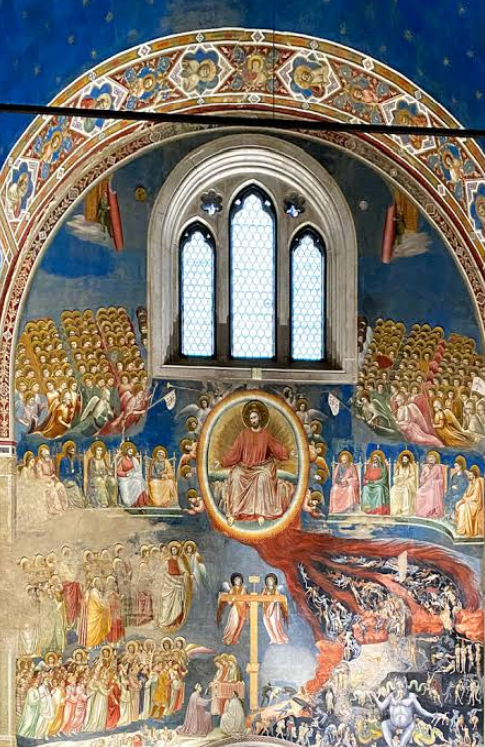
Evil does not mean God is absent, evil, indifferent, or powerless. If God blocked every evil in advance, there would be no stable order or real responsibility. That God sustains even those who reject Him is mercy, not approval of evil. God’s partial hiddenness preserves freedom so we do not choose Him only for the prize. These reasons show that the existence of evil does not overturn God’s goodness.
The argument

When we see injustice, pain, or tragedy, it is natural to ask: “If God is good, why does this happen?” Yet human experience itself shows that love has value only when it is free, and freedom involves risk. Loving parents do not control every move of their children; they educate, love, and guide them, allowing them to err. Likewise, God’s permission of evil does not contradict His goodness: it reveals a God who takes our freedom seriously, sustains the world’s order, and, through His providence, can draw greater goods from difficulties — just as we turn failures into lessons learned. Evil is real; it is not proof that God is missing, wicked, cold, or weak.
- Alvin Plantinga - God, Freedom, and Evil
- C.S. Lewis - The Problem of Pain
- Wisdom 11:24 - You love all things that exist and loathe nothing you have made.
- Romans 8:28 - We know that all things work together for good for those who love God.
- 2 Peter 3:9 - The Lord does not delay... but is patient with you.
Imagine a simple situation: every time someone tried to harm another with a weapon, it would disintegrate. At first glance, this might seem good, but soon everything would become unpredictable. Objects would vanish, natural laws would shift, and no one could learn from choices or take responsibility for actions. How could you drive if your car might disappear to prevent any mistake? Without stability, there is no science, justice, or virtue. That’s why God maintains a consistent world where choices have consequences — only then can freedom, repentance, maturity, and true love make sense.
- Richard Swinburne - Providence and the Problem of Evil
- Alvin Plantinga - God, Freedom, and Evil
- Ecclesiastes 3:1 - There is an appointed time for everything.
- Sirach 15:14 - God... left man in the power of his own decision.
- Galatians 6:7 - God is not mocked; whatever a man sows, that he will also reap.

If those who err were erased from existence, there would be no second chances, forgiveness, or growth. In everyday life, we admire those who, though hurt, allow time for others to change. God, our Father, does not support evil but preserves every person’s being and grants opportunities for repentance — like a farmer who does not uproot a sick tree but prunes and tends it, waiting for fruit. He is perfectly faithful: He does not create today and destroy tomorrow out of whim. By sustaining even those who do evil, He does not approve of their actions but respects the order He established and offers time for conversion. Like a doctor who preserves a patient’s life to heal him, God maintains existence, calls to repentance, and when welcomed, restores the heart. This patience is not indifference; it is mercy consistent with the original goodness of creation.
- Thomas Aquinas - Summa Theologica (On Divine Providence)
- Matthew 5:45 - He makes His sun rise on the evil and the good.
- Ezekiel 33:11 - I take no pleasure in the death of the wicked, but rather that he turn from his ways and live.
- Luke 15:7 - There will be more joy in heaven over one sinner who repents.

When a great reward is at stake, it is easy to act only for the prize. If we saw God in all His glory now, choosing Him would be irresistible and would no longer express free love. God therefore “speaks softly” — in conscience, in the beauty of the world, in encounters, and in history — offering enough light for the one who seeks Him without overwhelming our will. It is like the morning light inviting us to open the window, not a spotlight that blinds. Thus, loving God is not opportunism but a wholehearted response to love freely offered.
- J. L. Schellenberg - Divine Hiddenness and Human Reason
- Eleonore Stump - Wandering in Darkness
- Isaiah 45:15 - Truly, you are a God who hides Himself.
- John 6:44 - No one can come to me unless the Father who sent me draws him.
- 1 Kings 19:12-13 - A gentle whisper... Elijah covered his face with his mantle.